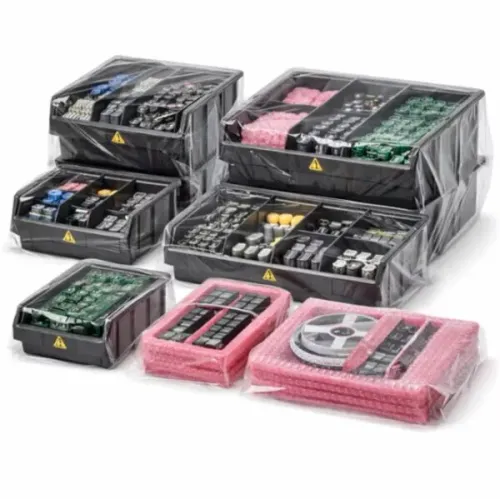
A bin labelled “ESD” is not automatically safe for PCB components: the material category, test data, dimensions and use environment determine whether it protects or increases risk. By the end, you will be able to specify the right bin, compare alternatives and request evidence that matches your receiving, assembly, storage and movement needs.
Key takeaways
- Choose conductive or static-dissipative bins, not ordinary plastic containers.
- Request surface-resistance test results, material details and lot traceability.
- Match bin dimensions and compartments to component size and handling workflow.
- Compare Pune suppliers on test evidence, customization, quantity and delivered cost.
What electrical category should an ESD bin have?
For PCB components, choose a conductive or static-dissipative bin, not an ordinary plastic box labelled only “ESD.” The usual resistance bands are:
| Electrical category | Resistance | Practical meaning |
|---|---|---|
| Conductive | Below 10^4 ohms | Drains charge quickly when grounded |
| Static-dissipative | 10^4 to below 10^11 ohms | Controls charge flow without a rapid discharge |
| Insulative or non-conductive | 10^11 ohms or higher | Holds charge instead of reliably draining it |
A conductive or dissipative bin organizes components during receiving, kitting, assembly, inspection, storage and internal movement, while reducing charge differences between the bin and its contents. It works only as part of a grounded system: connect racks and work surfaces to ground, verify personnel grounding, and keep charged insulators away.
The bin alone does not make an ordinary workstation ESD-safe.
“Anti-static” describes a material’s tendency to generate or retain less static charge; it does not prove grounding, charge dissipation or electrostatic shielding. Black plastic is not proof of conductivity because colour does not specify resistance or carbon content.
The search term “non conductive ESD bin boxes in Pune” is technically misleading: an insulating box can accumulate charge and is unsuitable on a grounded ESD workstation unless the component has separate ESD protection.
An open bin also does not shield parts from charged objects during transport between facilities; use suitable ESD protective packaging for that movement.
What ESD evidence should you request from a supplier?
Request evidence for the completed box, not just a polypropylene, ABS or HDPE material name. Wall thickness, colourants, carbon additives, mould texture, contamination and surface coatings can change resistance readings, so a supplier’s ESD label proves little by itself.
Ask the supplier for:
- Surface-resistance results and, where relevant, volume-resistance results for the supplied model, with the test method, electrode arrangement, test humidity, temperature, date, batch reference and applicable production specification. Methods may include ANSI/ESD STM11.11 and STM11.12.
- Charge-generation or charge-decay data, including the test method and result. Request documentation tied to the production batch, not a generic polymer datasheet.
- An EPA-use sample for testing on your grounded work surface. Ground the rack, remove insulating liners, verify personnel grounding and prevent a charged item from entering the box during the check.
Evidence differs by handling purpose:
| Use | Evidence to request | What the bin does not prove |
|---|---|---|
| Inside an ESD Protected Area | Finished-bin resistance, charge behaviour and grounding suitability | It does not make an ungrounded workstation safe |
| Movement between facilities | Protective-package or shielding data for the packed component | An open bin organizes parts but does not shield them from charged objects or electrostatic fields |
A supplier claim alone does not establish ANSI/ESD S20.20 or IEC 61340-5-1 compliance. For ESD storage bins in Pune, specify the surrounding control system as well. Moisture-sensitive devices still need moisture-barrier bags, desiccant, humidity indicators and applicable floor-life controls.
How do you choose dimensions, compartments and handling features?
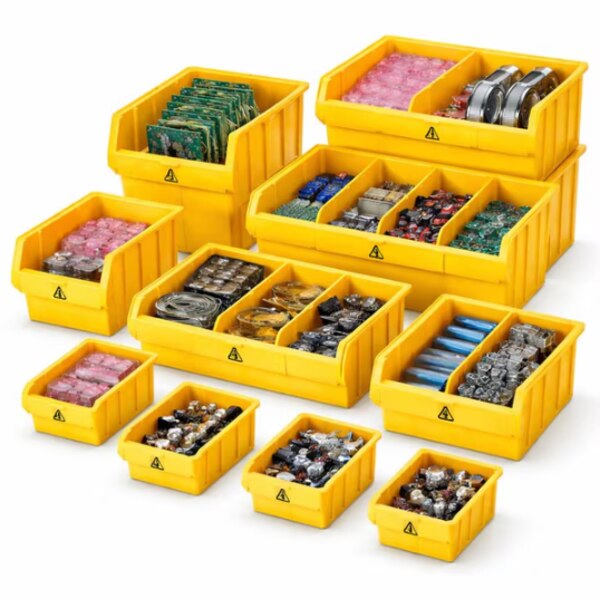
Measure the component before comparing bin exteriors. Record its footprint, lead protrusion, connector height, reel diameter, IC-tray size and required clearance. Then specify internal length, width, height and usable volume; tapered walls, stacking rims and lid recesses reduce capacity.
- Use tight fixed cells for small connectors and loose components that must not shift. Use removable dividers when kitting lists change.
- Set divider pitch wider than the widest component plus handling clearance. Choose taller dividers when parts could cross into neighbouring compartments.
- Require smooth walls, rounded corners and secure partitions. Exposed metal can snag leads, abrade insulation or short contacts.
- Ask for load rating, stacking rating, empty-bin nesting behaviour and impact performance under repeated warehouse handling.
Match features to the work area:
| Use | Specify | Why |
|---|---|---|
| Workstation | Open sides, handles, label holder | Fast picking without trapping leads |
| Rack storage | Stacking feet, closed sides, secure lid | Stable vertical storage and dust control |
| Inspection point | Front label holder, removable dividers | Quick identification and reconfiguration |
| Warehouse movement | Lid, impact-resistant walls, rated handles | Protects contents during repeated handling |
For esd bin boxes in pune, qualify a sample with the actual PCB components, reel or IC tray. Check that the lid closes without crushing parts, dividers stay seated, and no clearance allows connectors to become trapped.
When is a bin better than bags, trays or ordinary containers?
A conductive or dissipative bin is the strongest choice for organised, reusable storage and internal movement inside a controlled ESD area. It speeds picking and kitting, but an open bin is not a transport package between facilities; enclose components in an ESD protective package for shipment.
| Format | Best fit | Trade-off |
|---|---|---|
| ESD bag | Individual component protection | Protects each item but slows picking |
| Shielding bag | Transport outside an EPA | Provides transport shielding; adds packing time |
| Conductive tray | Flat PCB assemblies or machine loading | Presents boards neatly but uses more rack space |
| Standard plastic bin | Non-sensitive goods | Offers no dependable ESD protection |
| Corrugated partition box | Low-cost, short-term segregation | Economical, but debris and weak ESD performance limit reuse |
| Metal container | Durable storage and shielding | Edges, grounding and component contact require control; dents can damage boards |
For esd storage bins in pune, match the format to the handling job, not the colour or label. Treat ESD and moisture protection separately: a dissipative bin does not replace a moisture-barrier bag, desiccant or humidity indicator.
If a bin faces cleaning, oils, flux residue, stacking or abrasion, request resistance results after the intended cleaning method and a mechanical-use test. Check smooth contact surfaces, protected edges and secure grounding before placing boards inside; uncontrolled metal contact can short or scrape components.
How should you compare ESD bin box suppliers and prices in Pune?
Compare landed cost per usable compartment, not the ESD bin box price in Pune per box. Divide the complete invoice cost by the number of compartments that actually hold your PCB components, reels, connectors or IC trays.
Ask every ESD bin box supplier in Pune for:
- Internal and external dimensions, material and additive description, colour, label-holder details, divider and lid options
- Surface- and volume-resistance results for the finished bin, test method, electrode arrangement, humidity, temperature, test date and batch reference
- Load rating, stacking rating, minimum order quantity, GST, freight, delivery lead time, batch traceability and sample-approval terms
Wall thickness, conductive compound, custom moulding, partitions, covers, printing and order volume all change the quoted price. A low unit price can become expensive when freight, GST, unusable tapered space or a large minimum order is added.
| Cost factor | Effect on your quotation |
|---|---|
| Standard mould | Lower tooling cost; limited dimensions |
| Custom mould | Tooling cost; exact fit for your component |
| Dividers, lids or printing | Higher unit cost; better segregation or identification |
| Larger order volume | Lower unit price; more inventory and cash committed |
Qualify a sample using the actual component. Check fit, lead clearance, divider stability and lid security, then test resistance on the grounded surface and confirm rack grounding. OM INDIA can be included in the enquiry, but request the same finished-product evidence, sample and commercial details from it.
Related products
 | ESD Bin Boxes Manufacturer & Supplier in Pune, Pimpri Chinchwad & Mumbai OM INDIA is a trusted manufacturer and supplier of PCB Storage ESD Bin Boxes, specially... View product → |
 | ESD Bin Boxes Manufacturer & Supplier in Pune, Pimpri Chinchwad & Mumbai OM INDIA is a trusted manufacturer and supplier of ESD Bin Boxes, designed to safely... View product → |
Frequently asked questions
What electrical category should an ESD bin have?
Choose a conductive or static-dissipative bin. Ask the supplier for its measured resistance range and test method instead of accepting an “ESD” label alone.
What ESD evidence should you request from a supplier?
Request a product datasheet, surface-resistance test report, material specification, test method, production-lot traceability and any declaration against IEC 61340-5-1 or ANSI/ESD S541.
How do you choose dimensions, compartments and handling features?
Measure the component trays or reels first, then specify internal length, width, height, divider layout, label area, stackability, handles and compatibility with your racks or shelves.
When is a bin better than bags, trays or ordinary containers?
Use bins for repeated picking, visible line-side storage and protected stacking. Use ESD bags for individual sealed protection, trays for organized automated handling, and never use ordinary plastic where static control matters.
How should you compare ESD bin box suppliers and prices in Pune?
Compare resistance evidence, dimensions, material, divider options, minimum order quantity, lead time, replacement availability, delivery charges and taxes alongside the quoted unit price.
Related products
 | ESD Bin Partition Boxes Manufacturer & Supplier in Pune, Pimpri Chinchwad & Mumbai OM INDIA is a trusted manufacturer and supplier of ESD Bin Partition Boxes, designed for... View product → |
 | ESD Bin Partition Boxes Manufacturer & Supplier in Pune, Pimpri Chinchwad & Mumbai OM INDIA is a trusted manufacturer and supplier of ESD Partition Boxes, designed for safe... View product → |
 | ESD Bin Boxes Manufacturer & Supplier in Pune, Pimpri Chinchwad & Mumbai OM INDIA is a trusted manufacturer and supplier of Conductive ESD Bin Boxes, designed to... View product → |
 | ESD Bin Boxes Manufacturer & Supplier in Pune, Pimpri Chinchwad & Mumbai OM INDIA is a trusted manufacturer and supplier of Non-Conductive ESD Bin Boxes, designed... View product → |
Keywords